Portland Sleep & Home Comfort
A Practical Guide to Choosing an Organic Crib Mattress
A crib mattress is a small, consequential purchase: it has to fit precisely, provide a firm and level surface, and stand up to the ordinary work of family life. Organic materials may matter to your household, but a label is only one part of the decision. Here is a clear way for Portland families to compare construction, fit, certifications, and care without mistaking reassuring language for a safety guarantee.
Published October 20, 2026
Begin with the sleep space, not the label
Shopping for a crib mattress can feel like entering a room where every object has acquired a vocabulary of its own. There is organic cotton, natural latex, wool, low-emission foam, waterproofing, quilting, certifications, and an impressive number of adjectives. The most useful first question, however, is plain: does the mattress fit the crib securely, and is it designed for that crib?
A mattress that is too small can leave a hazardous gap at the sides. Before ordering, check the crib’s manual for the mattress dimensions and any restrictions on thickness or type. Measure the interior of the crib as well, particularly if it is older, converted, or not a standard size. Compare those measurements with the mattress maker’s stated dimensions, and ask the manufacturer if anything is unclear. A product described as “standard” is not a substitute for confirming compatibility with the particular crib in your home.
Once installed, the mattress should sit level and snugly within the frame. Follow the crib and mattress manufacturers’ instructions for checking fit; do not improvise with rolled towels, extra padding, or other materials to fill a gap. Inspect the setup again after changing the mattress height or moving the crib. A good fit is not a minor convenience. It is a basic part of creating a safe sleep space.
Families should also consult current safe-sleep guidance from trusted pediatric health authorities, such as the American Academy of Pediatrics and the U.S. Consumer Product Safety Commission. Recommendations can be updated, and the instructions supplied with a specific crib or mattress matter. In general, infant sleep calls for a firm, flat, separate surface with a fitted sheet, without soft objects or loose bedding. An organic claim does not change those principles.
What “organic” can—and cannot—tell you
“Organic” is meaningful only when a shopper can identify what was certified, by whom, and under which standard. A mattress may contain several materials, each with its own supply chain: the outer fabric, batting, filling, adhesives, waterproof layer, and internal support. A certificate covering the fabric does not necessarily certify every component or the finished mattress. Read the scope of the claim rather than allowing one prominent word to stand in for a complete materials statement.
GOTS, the Global Organic Textile Standard, applies to qualifying textile products and sets requirements related to organic fibers and processing. GOLS, the Global Organic Latex Standard, applies to certified organic latex. These are different standards, not interchangeable badges. If a company cites a certification, look for a current certificate, the certifying organization, and a clear explanation of which product or component it covers. If a listing says only “made with organic materials,” ask what share of the product that describes.
Other terms are useful but less precise. “Natural” does not automatically mean organic; “chemical-free” is an especially sweeping phrase, since every material is made of chemicals. “Non-toxic” may sound conclusive without telling you which substances were assessed or how. More helpful information includes a full materials list, specific testing or certification details, and an explanation of the product’s construction.
These distinctions are not an argument against organic materials. They are a way to compare them honestly. A family may prefer certified organic cotton or latex for environmental, sourcing, or personal reasons. Another may prioritize a particular waterproof surface, a lighter mattress, or a lower price. The important thing is to understand what is being claimed and how it relates to the finished product.
Firmness, construction, and the feel of a mattress
For an infant, a crib mattress should be firm and flat, not plush or pillow-like. Firmness here is a safety characteristic, not a promise that every adult will find the surface comfortable. A mattress can feel unyielding to a grown-up hand and still be the appropriate kind of surface for an infant. Do not judge suitability by pressing it briefly in a showroom or by adding a soft layer to make it feel more inviting.
Crib mattresses are commonly made with foam or innerspring construction, and some use latex or combinations of materials. Construction affects weight, handling, and the way the product is cleaned, but a material name alone does not establish that a mattress is safe or suitable. Look for the product’s age and use guidance, its compliance information, and its care instructions. Confirm that it is intended for the crib or sleep space you have, rather than assuming that any small mattress will do.
Weight can become surprisingly important during the first months of parenthood, when a fitted sheet may need changing at an hour that has not been scheduled. A lighter mattress may be easier to lift and turn for cleaning. A heavier one may reflect a different construction. Neither quality is a virtue in isolation; it is a practical consideration to weigh against the mattress’s other features.
Also ask whether the mattress is designed to be used on both sides, whether the manufacturer gives different guidance for infants and toddlers, and how the product should be oriented. Some models have distinct infant and toddler surfaces; others do not. Do not infer a second stage from a mattress’s appearance. Use it only as described in its instructions, and do not flip or rotate it unless the manufacturer says to.
Waterproofing and the question of upkeep
Mattress care deserves attention before the first spill, not after it. Babies make laundry a recurring part of household life, and a mattress that cannot be cleaned as expected may frustrate even the most organized parent. Manufacturers use different approaches: some have a wipeable surface, some rely on a removable cover, and others specify spot cleaning only. Read the instructions before purchasing, especially if you expect to wash a cover frequently.
Ask whether the cover can be removed, whether it is washable, what detergent and water temperature are allowed, and how long it should dry. Check whether the mattress itself must remain dry and whether cleaning products, steam, or direct heat are prohibited. A washable cover is not automatically a machine-washable mattress; the distinction matters. If a cover is removed for laundering, follow the manufacturer’s directions for reassembly and ensure the sleep surface is set up correctly before use.
Water resistance is another trade-off to understand. A barrier may make cleanup easier, but its materials and care requirements should be disclosed. If a family is comparing a waterproof surface with a more breathable textile, the decision is not simply “natural versus practical.” It is a question of what the product contains, what it protects against, how it is maintained, and whether it meets the family’s needs while preserving a firm, flat sleep surface.
Portland’s rainy stretches can make drying laundry and ventilating rooms less straightforward. That does not mean a crib mattress requires special treatment, nor does damp weather justify adding a soft layer or improvised cover. It does make clear care instructions useful. Allow washable components to dry completely before reuse, keep the room reasonably ventilated, and follow the manufacturer’s guidance rather than relying on a household shortcut.
Mattress pads: a careful distinction
A mattress pad is not a crib mattress. Pads can add cushioning and protect a mattress, but anything placed over an infant’s sleep surface must be considered in light of current safe-sleep recommendations and the mattress and crib makers’ instructions. The safest default is not to add a topper, quilted layer, pillow, or other soft accessory to an infant’s sleep space unless it is explicitly permitted by the relevant product instructions and is consistent with pediatric safe-sleep guidance.
This is worth spelling out because bedding categories often place crib pads beside adult mattress protectors, making them seem like routine accessories. They are not interchangeable. For an infant, use a properly fitted sheet on the firm, flat mattress and keep the sleep space free of loose bedding and soft objects. If you are considering a pad or protector, check its intended age and use, fit, thickness, attachment, and the crib and mattress manufacturers’ instructions. When the guidance is unclear, ask the child’s pediatric clinician rather than guessing.
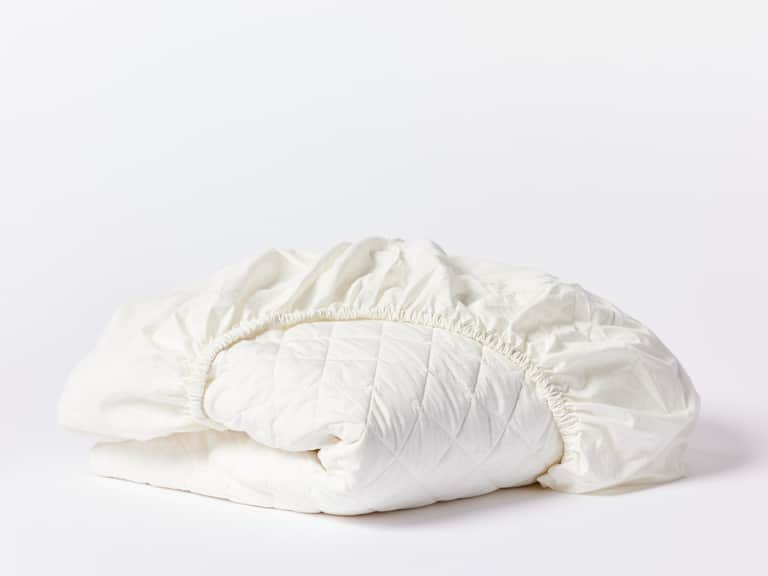
For example, an organic cotton mattress pad is described as a cushioned layer made with organic cotton batting and a percale cotton cover, with quilted squares and full elastic. Those characteristics may be relevant to evaluating an adult bedding accessory, but the listing alone does not establish that the pad is suitable for an infant crib. Do not use a product in a crib simply because it is labeled organic, cotton, or “mattress pad.” Confirm its intended use and follow authoritative safe-sleep advice.
A Portland household’s practical checklist
Local context is useful when it leads to sensible questions rather than sweeping claims. Portland homes vary widely: a newer apartment may have a different temperature and ventilation pattern from an older house, and a nursery’s location can affect how easy it is to keep the room comfortable. Instead of assuming that every home shares the same conditions, consider the room where the crib will actually be used.
- Measure the crib. Check the interior dimensions and the crib manual; compare them with the mattress’s stated size and thickness.
- Confirm intended use. Verify that the mattress is made for the specific crib and age range, and follow its orientation and stage instructions.
- Read the materials list. Identify the cover, filling, waterproofing, adhesives, and other components where disclosed.
- Check certification scope. Find out whether a certification applies to a fabric, a filling, or the whole finished product.
- Plan for cleaning. Note whether the cover is removable, what can be washed, and how each part should be dried.
- Review safety information. Look for applicable compliance details, product warnings, and any recall information. Keep the model name and receipt for your records.
- Think about everyday handling. Consider mattress weight, sheet changes, delivery access, and whether the product fits your household routine.
- Keep the sleep surface simple. Use a fitted sheet and follow current guidance from trusted pediatric health authorities; do not add items to compensate for a poor fit or perceived firmness.
When shopping in person, ask the same questions you would ask online and request written details rather than relying on a salesperson’s shorthand. When shopping online, locate the actual manual and warranty before checkout. If a listing omits dimensions, care instructions, certification specifics, or the intended age range, contact the maker. A quick answer can be more valuable than another paragraph of promotional copy.
Price, lifespan, and the meaning of “investment”
Organic crib mattresses can cost more than conventional options, but price alone does not reveal quality, safety, or environmental impact. Compare products by construction, certification, care requirements, warranty terms, and the manufacturer’s stated service life. A long warranty is not the same as a guarantee that a mattress will remain appropriate for every child or every use; read what it covers and what it excludes.
It is also sensible to ask whether the maker recommends using the same mattress for another child, and under what conditions. Follow its instructions about inspection, wear, cleaning, and replacement. If the mattress is damaged, has a compromised cover, no longer fits the crib, or has an unknown history, do not assume that a fresh sheet makes it suitable. When the product’s condition or safety is uncertain, seek guidance from the manufacturer or a qualified health professional.
For families who value organic bedding, a considered purchase can mean choosing a clearly documented product that fits the crib and can be maintained as directed—not buying the most elaborate description. A modest, well-understood mattress may be a better match for a household than a more expensive one whose claims are difficult to verify or whose upkeep is inconvenient.
Questions worth asking before you buy
- What are the mattress’s exact dimensions, and which crib models or dimensions does the maker identify as compatible?
- Is the mattress firm, flat, and intended for infant sleep according to its manufacturer?
- Which materials are used in the core, cover, and any barrier or bonding components?
- What does each certification cover, and can the company provide current documentation?
- How should the mattress and cover be cleaned, and what must not be used on them?
- Does the maker permit a mattress pad or protector, and what exact type, if any, does it specify?
- What are the warranty, return, and replacement terms, and where can current safety notices be found?
The useful answer is often the specific one
Choosing an organic crib mattress is not a test of how many certifications a parent can memorize. It is an exercise in separating the essential from the appealing: a snug fit, a firm and flat surface, clear product information, safe use, and care instructions that a real household can follow. Organic materials and credible certifications may help distinguish products, but they cannot replace those fundamentals.
For Portland families, the best decision is one grounded in the crib in the nursery, the room’s practical conditions, and the manufacturer’s documented guidance. Measure first. Read beyond the headline claim. Ask what a certification actually covers. Treat accessories with particular care, and check current pediatric recommendations before adding anything to an infant’s sleep space. The result may not be the most ornate purchase in the nursery, but it can be the most considered one: quiet, well-fitted, and ready for the work of every night.